AI development · AI engineers for your team · Custom software · Game backends
Yarvixo builds AI software that holds under production load
Two ways to buy it: AI engineers who join your team, from $4,000 a month, or a team that delivers the whole build at a fixed price. The engineering behind both already runs 52,000 concurrent players at 62 ms average round-trip and 99.98% uptime. Senior engineers only, and you own the IP from day one. Two of the cases below are named and public — go and check them.
An enterprise AI platform across 14 sources and 5 languages, for one anonymised client.
Same system. A measurement, not an estimate — an evaluation harness was built to take it.
A different system: one anonymised game backend, in production, at 62 ms average round-trip.
Trusted by companies across Europe & North America






Work
The first three are named, so you can go and look at them — a retail console game you can buy in the eShop, a client game live on Google Play, and our own product. The other three are client work and stay anonymised until we have written permission.
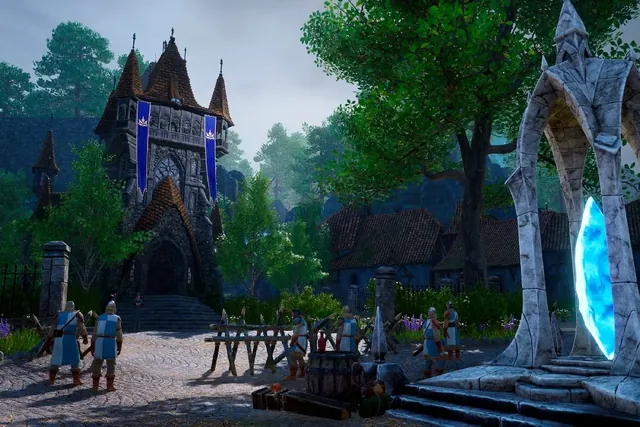
Screenshot: Nintendo eShop listing. King’s Bounty II — 1C Entertainment / Prime Matter.
King's Bounty II — Nintendo Switch Port
An Unreal Engine 4 open world built for PC wanted about 7 GB of memory and ran at 6–8 fps on a devkit. A Switch has 4 GB on the whole device. Nothing in the game was allowed to be cut to close the gap.
Five engineers, twelve months: texture pool budgets, LOD and asset repacking to fit memory, a character streamer rewritten from scratch once the CPU became the limit, and a fixed resolution set separately for docked and handheld — pixels spent so the content did not have to be.
Result: shipped day and date with PC, PS4 and Xbox One on 24 Aug 2021 · 30 fps target from 6–8 fps, with nothing cut · still on sale, and supported on Switch 2
The Switch column is ours. It lands level with the PC build and six above PS4, on hardware with a fraction of the memory of either.
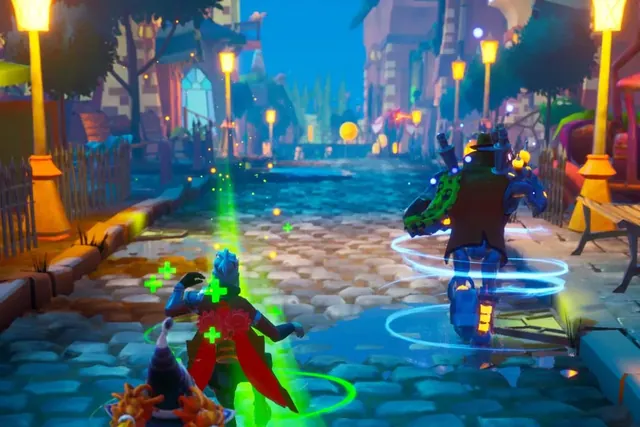
Screenshot: Google Play listing. Metarun — Encore Games.
Metarun — 1v1v1 Web3 Mobile Runner
A runner is single-player by default. Making it a ranked 1v1v1 race over mobile networks means the device can no longer be trusted with the result, and in a title with tradable assets an exploited race is something the exploiter keeps.
Six engineers, four months of active development: Unreal Engine client for Android and iOS, server-authoritative match services deciding the race off-device, MMR matchmaking and ranked leagues, anti-cheat, and hero ownership on BNB Chain — ownership on-chain, gameplay off it.
Result: 39,000 concurrent players at its event peak, 60 ms average round-trip, 99.8% uptime in production · live on Google Play with 50,000+ downloads and 4.0 from ~2,970 reviews, per Google · named with the client's permission, so you can install it and check
Read full case study →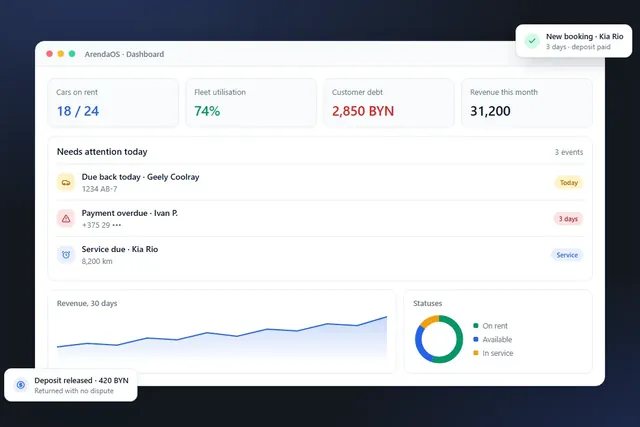
Our own product. Dashboard rendered from the live ArendaOS markup, in English — illustrative rows, no real customer data.
ArendaOS — Fleet Rental SaaS
Car-rental operators run deposits, debts, fines, damage disputes and maintenance out of spreadsheets and group chats, and nobody can answer who owes what today.
A multi-tenant B2B subscription platform on NestJS and PostgreSQL — twelve modules, seven roles, PDF contracts, encrypted personal data, and overlapping bookings refused by a database constraint.
Result: shipped and live at arendaos.com · 12 modules full-stack and multi-tenant · zero double bookings, enforced in the database
Read full case study →Anonymised client work — no name, no link to verify, listed as such
Multiplayer Game Backend
Go microservices, Redis pub/sub, Kubernetes autoscaling, custom matchmaking. 52k peak CCU · 62 ms · 99.98% uptime.
Read → Web3Decentralised NFT Marketplace
Gas-optimised contract suite on Polygon with subgraph indexing and real-time feeds. $2.4M first-month volume, per the client.
Read → AI SaaSEnterprise AI Analytics Platform
Multi-model LLM pipeline with custom RAG across 14 data sources in 5 languages, wired into an existing ERP. 87% less manual processing, 99.2% extraction accuracy, live in 10 weeks.
Read →Where the numbers come from
52,000 concurrent players, 62 ms average round-trip and 99.98% uptime are not three wins from three projects — they are one backend, and this is that backend. Each figure carries the condition the case study records it under.
Drag the drawing sideways →
What we build
AI work first — built for you, or by our engineers on your team — with the real-time and Web3 engineering that evidences it.
AI development
LLM integration and fine-tuning, RAG systems, agents and pipelines — built into a product that already exists, rather than bolted alongside it. The platform behind the 87% above is a custom RAG across 14 sources in 5 languages.
AI development → 02AI engineers for your team
Senior AI engineers on your board, in your repo and your standups — retrieval, LLM integration, evaluation and agents. $4,000–$7,000 per engineer per month, three-month minimum, starting within 1–2 weeks.
Hire AI engineers → 03SaaS development
Multi-tenant B2B platforms, API-first, MVP in 8–12 weeks. ArendaOS is ours end to end and is the one you can open in a browser today.
SaaS development → 04Smart contracts
Contract engineering, dApps, NFT infrastructure and game economies. On Metarun the split was deliberate: ownership on BNB Chain, gameplay off it.
Smart contracts → 05Game development
Multiplayer systems, game backends and full-cycle production in Unity and Unreal Engine — including console ports through certification. King's Bounty II shipped to Switch on this work.
Game development → 06Multiplayer backends
Authoritative servers, matchmaking, ranked leagues and anti-cheat. The 52,000-CCU deployment above runs on Go microservices with Redis pub/sub and Kubernetes autoscaling.
Multiplayer backends →AI work by what it adds: an AI MVP when the AI is the product, AI integration into a product you already run, AI agents that act on your systems, and AI document processing for the documents off-the-shelf tools cannot read. Engineers for any of it, or for Unreal, Unity, Go and Solidity work, through staff augmentation.
The stack
What we actually reach for, grouped by where it runs. We are not dogmatic about tooling — but these are the things we have shipped and can support at three in the morning.
AI
- RAG pipelines
- LLM integration
- Agent orchestration
- Evaluation harnesses
- Vector search
- LLM fine-tuning
- PyTorch
Game clients
- Unreal Engine 4 / 5
- Unity
- C++
- C#
- Nintendo Switch
- PlayStation
- Xbox
- iOS / Android
Servers & real-time
- Go
- Node.js
- NestJS
- Python
- WebSockets
- gRPC
- Authoritative netcode
- Matchmaking / MMR
Data
- PostgreSQL
- Redis
- MongoDB
- ClickHouse
- S3
- Exclusion constraints
Infrastructure
- Kubernetes
- Docker
- Terraform
- AWS
- GCP
- CI/CD
- Prometheus
- Grafana
Web3
- Solidity
- BNB Chain
- Polygon
- Ethereum
- Subgraphs
- Contract audits
How we work
Six stages, transparent at each one: weekly demos, live dashboards and direct access to the engineers doing the work.
Discovery
Requirements, scoping, team setup. A written scope with a fixed price against it within 48 hours of the call.
Architecture
System design and the technology decisions, made before anyone writes production code.
Development
Agile sprints with mandatory code review. Weekly demos of something that runs.
Testing
QA, security and performance audits — unit, integration and end-to-end, in CI.
Launch
CI/CD and production deployment, with the runbook handed over alongside the code.
Support
Monitoring, incident response, scaling and iteration — or a full handover to your own team.
Let's build your next product
Three of our cases are named and public: you can buy one in the eShop, install another from Google Play, and play a third free in VR. Start with a call and we will tell you what we would actually do — and what we would not.
Writing
The questions that come up on almost every first call, answered in public at the length they actually need. No gated PDFs.
AI development outsourcing: what to buy, and what it costs
A fixed-price project, team extension or an in-house hire, in published prices — and the running cost most quotes leave out: about $0.011 per answer.
AI · HiringHow much does it cost to hire an AI engineer?
BLS salary data, what an employer pays on top of it, and team extension at $4,000–$7,000 a month, side by side.
ArchitectureGame backend architecture for 50,000 concurrent players
What the stack looks like, why each part is there, and the four things that break first on the way up.
EnginesUnity or Unreal Engine 5 for a multiplayer game?
Unreal 5 ships production replication and is the default for high-fidelity PC and console. Unity wins elsewhere, and where is the point.
AIRAG or fine-tuning: which does your product need?
Almost always retrieval. Fine-tuning changes how a model behaves; retrieval changes what it knows. One question tells you which you have.
DatabasesPreventing double bookings in PostgreSQL
An exclusion constraint instead of application validation — the approach behind the zero double bookings in ArendaOS.
Questions
Everything worth knowing before we start working together.
Get in touch
Fill in the form or reach out directly — we respond within one business day.
Start a conversation
Whether you have a detailed brief or just an idea, we're happy to help you figure out the best path forward. No sales pressure — just an honest conversation.
Message received
We'll review your enquiry and respond within one business day.